
New York has some of the richest historical records in the country. Too often, those records are difficult to access, slow to obtain, or locked behind outdated rules that do not serve the public. My advocacy work focuses on changing that.
As a professional genealogist, I rely every day on public records to reconstruct families and solve historical problems. When those records are inaccessible, I cannot do my job. Families lose access to their own histories. Researchers lose evidence. Attorneys, heirs, journalists, historians, and ordinary New Yorkers are forced to wait years (or a lifetime) for documents that should be available as a matter of course. I work to make xNew York’s historical records easier to find, request, and use. That work has included legislative advocacy, FOIL litigation support, public testimony, media commentary, and public education for genealogists and researchers.
In 2025, I testified in Albany before the New York State Legislature against proposed restrictions on access to historical vital records. I have also supported efforts to expand access to New York birth, marriage, and death records, including legislation that would move the state toward online publication of older records.
Through my work with Reclaim the Records and the Association of Professional Genealogists, I have helped challenge agency practices that keep public records unnecessarily closed. In litigation involving the New York State Death Index, I submitted an affidavit addressing the Department of Health’s claims about its records and explaining why death indexes are essential public finding aids. That affidavit ultimately helped secure access to the full New York State Death Index, 1880–2017.
I also write and speak publicly about records access. My commentary has appeared in the Albany Times Union, The Capitol Press Room podcast , testimony at public hearings, and conference around the globe. The goal is always the same: to explain why these records matter, how access actually works, and what can be done when government agencies delay, deny, or overcomplicate access.
Testimony to the New York state legislature, February 2025
On February 11, 2025, I testified before the New York State Legislature at the Joint Legislative Public Hearing on the 2025 Executive Budget Proposal, during the Health/Medicaid portion of the hearing. Appearing alongside D. Joshua Taylor, President & CEO of the New York Genealogical and Biographical Society, I spoke in opposition to proposed restrictions on access to New York vital records. The testimony begins at approximately 8:58:00 in the hearing video, with questions for Alec Ferretti and D. Joshua Taylor beginning around 9:18:30.
Interview with Dave Lombardo, March 2026
The Capitol Pressroom is a leading New York public affairs program focused on state government and politics. Hosted by David Lombardo and produced by WCNY, the show features interviews with lawmakers, advocates, journalists, and policy experts about the issues being debated in Albany and their impact on New Yorkers.
Dave interviewed me as the subject matter expert on vital records policy, and we had a productive discussion about the issues plaguing the Bureau of Vital Records at the New York State Department of Heath.
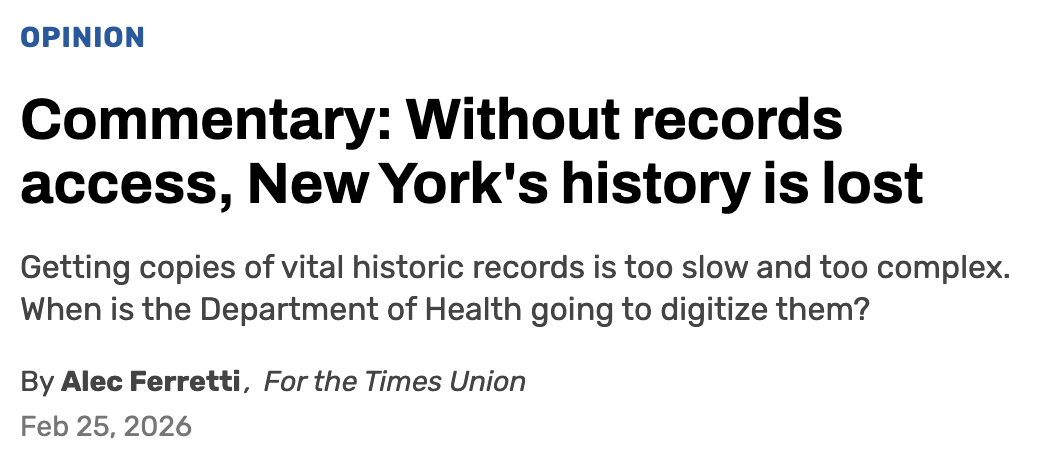
In an op-ed published in the Albany Times Union, I argued that New York’s historic vital records system is failing the public. The piece highlights the Department of Health’s backlog of roughly 12,000 requests, with typical waits of about five years for uncertified historical records and up to a year for some certified records needed for legal purposes. I urge the Department of Health to digitize and publish New York’s historic vital records online, following the lead of other states and the direction already set by the Legislature.
Expert affidavit, January 2023
In January 2023, I submitted an affidavit in Reclaim the Records v. New York State Department of Health, a FOIL case seeking access to New York State death index records. Drawing on my experience as a professional genealogist and archivist, I explained why these records exist, why they are legally and practically accessible, and why the Department of Health’s privacy and fraud objections were unsupported. My affidavit compared New York’s restrictive approach with the practices of other states, documented evidence that DOH maintained additional death index data, and argued that public access would help preserve fragile records, reduce agency backlogs, and allow families, researchers, and historians to recover New York’s past.
That affidavit helped build the factual record that made the case successful. When the New York Court of Appeals issued its 2025 decision, it discussed evidence I had submitted about the public availability of comparable death indexes in neighboring states, the lack of any demonstrated connection between public death indexes and identity theft, and DOH’s inability to identify records supporting its fraud concerns. The Court ultimately rejected DOH’s attempt to withhold the basic death index fields it already published for earlier years and ordered disclosure of those same categories of information for deaths from 1957 through 2017. Although the Court reserved some additional fields for further review, the decision was a major victory for public access, genealogists, historians, and families seeking to recover New York’s past.