Antisocial Security
I have some bad news for any frequent requesters of Social Security Administration (SSA) records. For the next few years, about 11 million SS-5 applications (the original application for a Social Security card) for people who are long deceased have been rendered potentially inaccessible. For the uninitiated, these are incredibly useful documents because they identify the birth information for essentially everyone who lived and worked from 1936 to the present (of course there are many technical exceptions to that, but as a general rule, most adults have a Social Security number). Deceased individuals' SS-5s are generally available via making a Freedom of Information Act (FOIA) request. As you can see in this SS-5, issued to Irving Chait, in 1936, he was born in Russia to Meyer Chait and Marry Feldman, or at least, that is how he reported their information. For more information about the SS-5, you can check out Judy Russell’s article, but some of the information and links are a little out of date because it was published 2.5 years ago. Their current request platform is at Social Security’s Public Access Link.
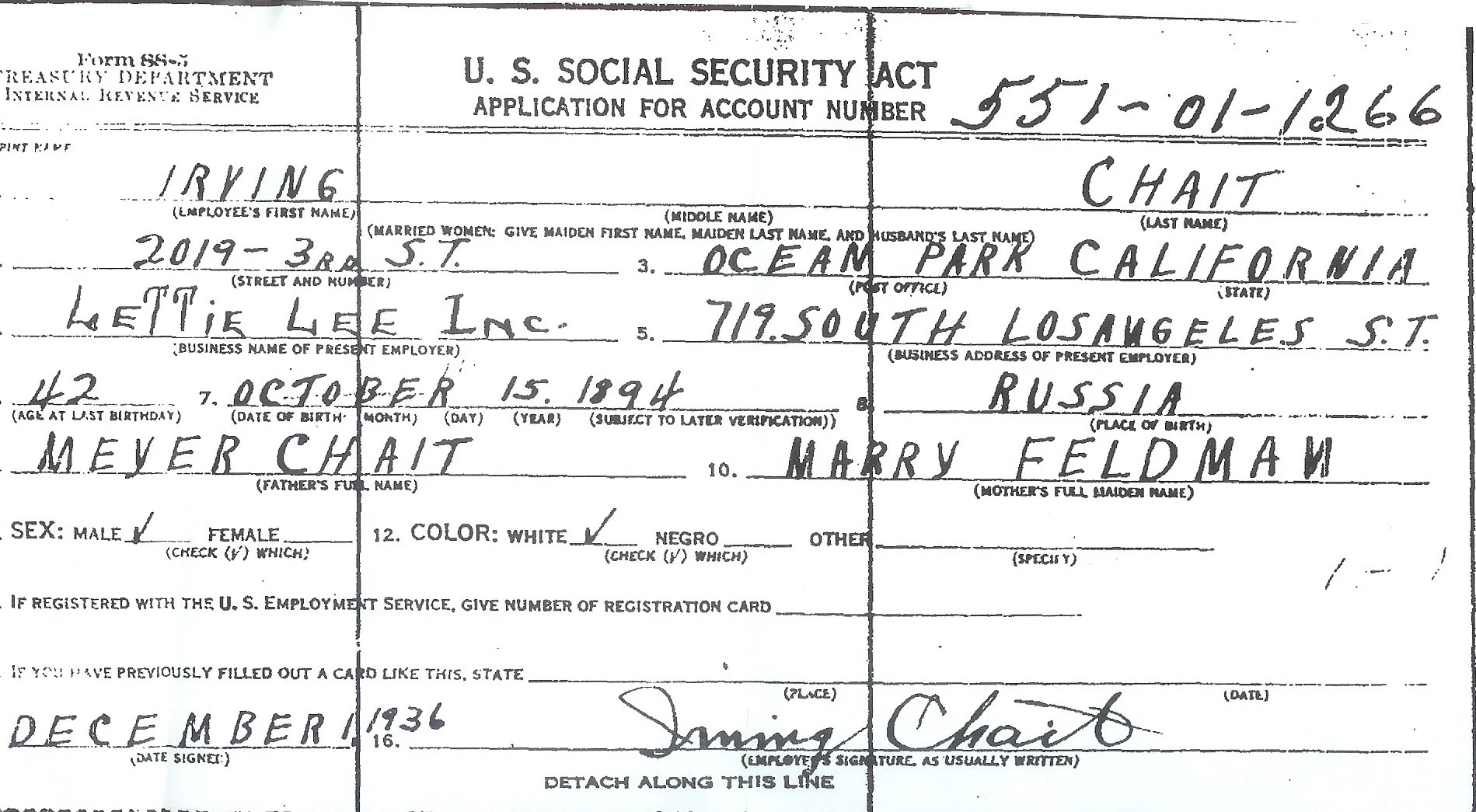
This was the first ever historical record that I purchased as a genealogist; 13 year old Alec spent $27 to learn Irving’s parents’ names. As it turns out, he was born in what is now Belarus, in a tiny shtetl called Vidzy.
Anyway, a truly bizarre sequence of events led to this issue, as the Department of Government Efficiency (DOGE), the needs of genealogists, and an obscure law from 2013 all found themselves in conflict. This all came to light when an unsuspecting genealogist made a seemingly routine FOIA request to Social Security for an SS-5 of someone born in the 1890s. The guy was a bit of a scoundrel and actually had two numbers. My friend knew this because he had two entries in the NUMIDENT database on Ancestry.
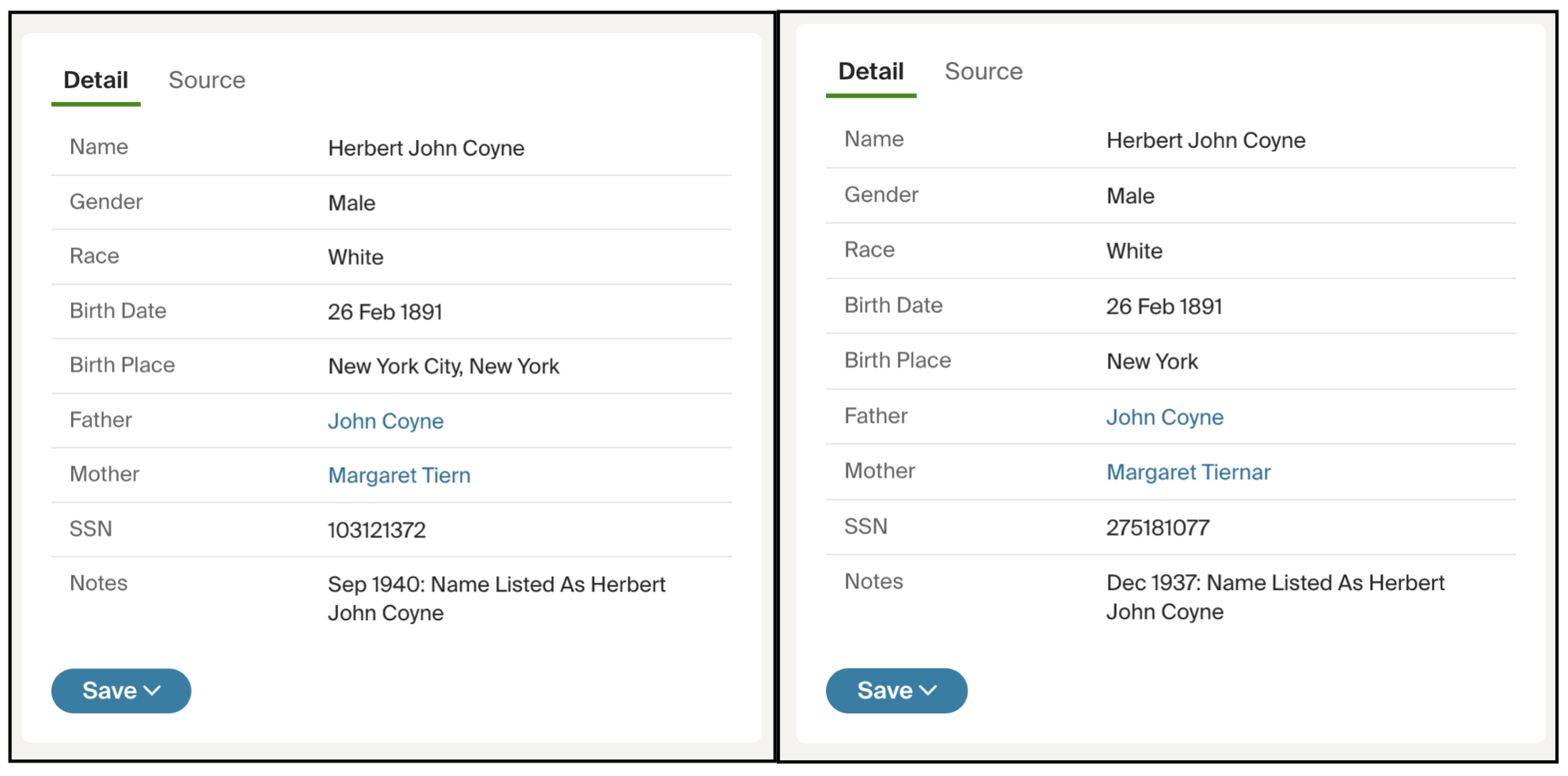
Two NUMIDENT records of Herbert John Coyne’s two different Social Security Numbers
Almost all SSA research begins with the NUMIDENT, so it might be worth taking a minute to talk about what that actually is. In short, it’s SSA’s database of number holders. It contains hundreds of millions of individuals’ biographical information, and is the closest thing that the United States has to a central population registry. It serves as the index to SS-5s, and it’s the starting point of just about anything Social Security would ever have to do with a person’s records. I have actually been waiting for 2.5 years for SSA to send me some information about the specific architecture of the NUMIDENT (properly called a data dictionary), but just this month, they reversed their position, and denied me access to the entire file citing the law enforcement exemption. I promptly appealed.
An extract of the NUMIDENT database was transferred to NARA in 2012 for individuals known to be deceased as of 2007 and individuals born 1897 or earlier. This was in accordance with a Records Control Schedule signed in 2009. This extract is available under different names on various websites. Ancestry has “U.S., Social Security Applications and Claims Index, 1936-2007”, MyHeritage copied their database name and has U.S. Social Security Applications and Claims, 1936-2007 while FamilySearch calls it United States, Social Security Numerical Identification Files (NUMIDENT), 1936-2007 . The original data files are also available through NARA’s Access to Archival (AAD) Database Portal, identified as Numerical Identification Files (NUMIDENT), created, 1936 - 2007, although split between Application (SS-5) Files, Claims Files, and Death Files. The full data is only available on NARA’s AAD site, with all of the other providers choosing to redact certain data fields, including Social Security Numbers, or parents’ names for younger, more-recent decedents. Although additional Social Security NUMIDENT records should have been transferred to NARA for people who died between 2007 and 2020, or without proof of death who were born in 1915 and earlier, SSA has not complied with its obligation and no additional records have been transferred. NARA Archivists decided that they were “willing to wait for SSA [to] approach us first.” Needless to say, I don’t expect a transfer for a long time.
My colleague didn’t know what happened to the guy after the 1940s, and was hoping that the SS-5s might provide some clues about where he was living and working. To her shock, her FOIA request was rejected because Social Security claimed they needed the subject’s proof of death, even though he was born in the 19th century. This conflicts with FOIA case law (death presumed after 100 years) and the agency’s stricter policy of death presumed after 120 years (which is already in violation of case law, but that’s another conversation). To state the obvious, Herbert was born 135 years ago, and even if he lived as long as Jeanne Calment, the oldest person known to have lived, he would still be dead. When she got the rejection, she assumed there was some sort of mistake, and she emailed the agency’s FOIA liaison, in the hope that she could smooth things over. Instead, she received this reply:
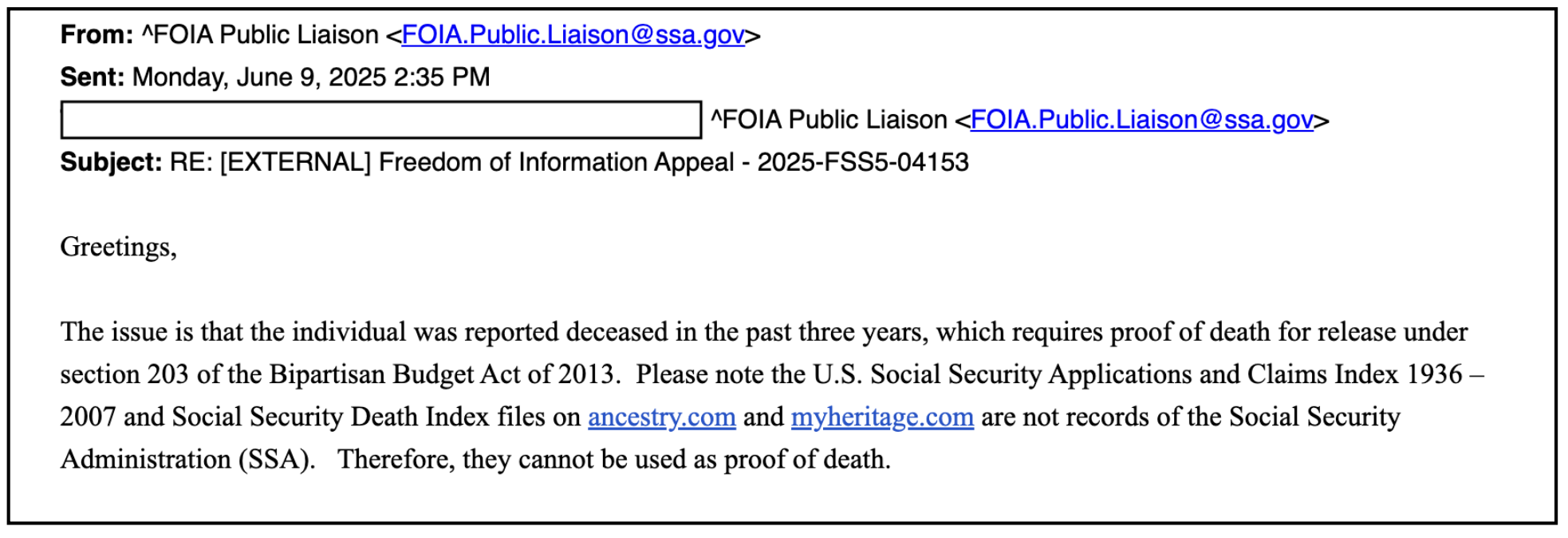
A cryptic response from the FOIA Liaison
Let’s break this email down, because there are a lot of things going on here.
Section 203 of the Bipartisan Budget Act of 2013—now 42 U.S.C. § 1306c—bars the Secretary of Commerce from putting a decedent’s information into the Social Security Death Master File (DMF) during the three-calendar-year period beginning on the date of the individual’s death. This is essentially why the DMF cuts off in 2014. Although genealogists call this data the Social Security Death Index (SSDI), this is just genealogy jargon for the version that was published by the commercial genealogy companies, and the underlying data is officially known as the DMF. It has been published by SSA for decades to provide timely access to information about number holders who passed away, but the 2013 Budget Act essentially ended the SSDI as we know it.
The DMF exist(ed) in the first place because of a consent decree dating back to a FOIA lawsuit from the 1980s, under which SSA agreed to proactively and regularly release extracts of deceased number holders from the NUMIDENT, including their names, dates of birth and death, and Social Security numbers, at least up until the 2013 law change, where Congress prohibited release of the data, creating a (b)(3) FOIA exemption in the law. However, if a FOIA requester supplies their own independent proof of death, then Social Security can “realize” the decedent is in fact a decedent and provide records on a case-by-case basis, but this still leaves the DMF closed off.
While we mere mortals can no longer see the bulk data for three years, the law created a pathway for early access for customers who obtain a National Technical Information Service (NTIS) certification under 15 C.F.R. Part 1110, which provides access only upon payment of a large fee and a promise to use the data only for certain fraud-prevention-related purposes or legitimate business purposes pursuant to a law, rule, regulation, or fiduciary duty. Like almost everything in genealogy access, this change happened because of overblown concerns about fraud. Tax-refund fraud was spiking and identity-theft crews were allegedly skimming SSNs from the DMF and filing phony returns. Social Security and taxpayer groups alike called for public access to be closed off.
Complicating things even more is that 42 U.S.C. § 405(r)(6) provides that Social Security cannot even acknowledge that an individual is dead if the proof of death they have comes from a Health Department (which is frequently the source of their information). This law dates back to the 1980s, but SSA didn’t entirely comply with it, leaving the DMF nearly complete. But after the 2013 change and the public DMF ceased to exist entirely, SSA started enforcing this as well. I have theorized that SSA might be restricting any individual’s records where a DOH source exists, even when they have other non-DOH sources as well, but confirming this will require more research.
Although the information about people who died more than three years ago and whose death came from sources other than State Departments of Health should be public information, as it is not exempt from FOIA, the government never instituted any plan to proactively release it (as had been the case under the consent decree), nor has it made it easily available to FOIA requesters (some people have gotten limited post-2013 data via FOIA requests, but getting even that involved high fees and/or litigation). Tens of millions of deaths could have rolled into a new public-use file by now, but instead, SSA and NTIS decided not to release one (see footnote 8 from SSA’s memo).
Seemingly, the litigants from the original lawsuit, Perholtz v. Ross, are no longer interested in going back to court about this, and in fact, they probably have their own death records at this point (bonus points to any genealogist who takes the time to figure out what happened to Perholtz). I have made numerous FOIA requests to both SSA and NTIS regarding their decision to not produce the public-use version, but I have yet to receive anything. Regardless, for genealogists, the data for the last decade is stuck behind statutory restrictions, certification fees and bureaucracy, making it effectively invisible to the public. If someone wants to fund some FOIA litigation for the 2010s-era data, please let me know!
Closing off the records is clearly not great (thanks Congress), and SSA’s failure to disclose otherwise-unrestricted records is not great either (thanks SSA), but how do we get from these restrictions on 2026 deaths to restrictions on information about someone born in the 1890s? That’s the fun part. The answer appears to be DOGE.
Between March 14 and April 19, 2025, the Social Security Administration ran a query that pulled every NUMIDENT record showing a birth year of 1905 or earlier for which the agency has no death information on file. This amounted to at least 11 million names. SSA then flagged each one as deceased and sent this new information straight into the Limited-Access Death Master File (DMF). The push came from the newly created Department of Government Efficiency (DOGE), which had a standing data-sharing role at SSA, and its stated goal was to fix the “records of individuals who are implausibly old to be living.” As a result, a new death-status flag now sits on every (or nearly every) individual born more than 120 years ago for whom there had previously been no such flag. DOGE framed this as a vitally important act that would prevent large amounts of improper payments, but it represented a fundamental misunderstanding of Social Security’s workflows.
SSA was already well aware of the missing data. An Inspector General audit had previously spotlighted millions of records of people born more than 100 years ago who had no death date, and Social Security put policies in place years ago to automatically cease benefits to extremely old claimants until they could provide adequate proof of life to the agency. This includes flagging beneficiaries over age 90 with no Medicare claims for three years and a program for beneficiaries living overseas. And in fact, the reason its database was incomplete was, in a rare case for the government, not due to negligence or some comedy of errors. It was just due to reality.
Simply put, SSA’s death reporting records go back to the mid-20th century, but because there is no federal registration of deaths, the information they had was always necessarily limited to that which was reported to it by funeral homes, departments of health, beneficiaries, etc. While its death information for people who die in the 21st century is very complete, this could not be the case for people who died in 1950, because today’s advanced infrastructure to report deaths just didn’t exist back then. Death registration before the computer age was diffuse and analog. Unless we hire teams of genealogists to confirm the death information of millions of people, their official death data will always be missing, and that’s not a big deal, because SSA knows not to remit payments to them anyway.
Let’s come back to the cryptic email from the FOIA liaison. Crucially, they misquoted the 2013 law, claiming that “The issue is that the individual was reported deceased in the past three years, which requires proof of death for release under section 203 of the Bipartisan Budget Act of 2013.” This is almost correct, minus one incredibly telling word. The access restriction covers people who died within the last three years, not people whose deaths were reported in the last three years. Although a report of death will promptly follow a death in nearly all cases (think about how quickly SSA claws back someone’s benefits after they die), the two concepts are distinct. As written in the email, the law purportedly restricts someone’s information for three years after SSA learned of their death, regardless of when that actually happened. And in the case of this FOIA request, it appears that SSA explicitly conceded that the individual, despite being born in the 19th century, only had their death reported in the last three years.
So what exactly happened? Some records have come to light in response to DOGE-related litigation indicating that the original plan was to assign the number-holder’s 120th birthday as their date of death (see page 21). Marking people of extreme age as deceased on an arbitrary day isn’t the end of the world, but it’s certainly not ideal to input fake data into a government database. It can have unintended consequences. Such as this. Seemingly, the DOGE project has somehow led to Social Security invoking the 2013 law that prevents disclosure of “recently” deceased individuals (for three years). But this cannot be the full story.
If the 120th birthday rule was used, then there would have been a few people affected by the collision of the 2013 law and the DOGE project (essentially, it would have been those born 120, 121, and 122 years ago), but the impact appears to be far more wide-reaching. Based on SSA’s denials, they are withholding SS-5s for seemingly everyone whose death information was artificially added by this project.
Despite the original plan, DOGE may have simply marked the 11 million people in their clean-up project as having died on some random date in early 2025, regardless of how old they would have been. If so, then the law would be triggered for everyone (at least ignoring the fact that this date of death is obviously a fake date of death).
In the alternative, the NUMIDENT might list the 120th birthday as the date of death for all these individuals, but SSA has decided that the date of the report is the operative date that binds them. The text of the original email, taken together with the litigation disclosures, suggests that this could be what is actually going on, but it makes no legal sense either. Let’s look at the statute:
The Secretary of Commerce shall not disclose to any person information contained on the Death Master File with respect to any deceased individual at any time during the 3-calendar-year period beginning on the date of the individual’s death, unless such person is certified under the program established under subsection (b).
This text is incredibly clear. The date of death is what controls here, and the date Social Security “learned” of the death has nothing to do with anything. So maybe DOGE used the date it had said it was going to use (which of course is also still a fake, meaningless date), and maybe SSA is deliberately misapplying the law for some reason. And maybe SSA has always used the “report date” when applying this law, but because report dates were usually mere days after the death, it never mattered, despite it being a technically incorrect thing to do. Regardless of the specific mechanism, SSA is screwing around with our access to these records, and the DOGE project seems to clearly be the start of it all.
Last summer, I submitted a FOIA request asking for “All legal memoranda, guidance, or interpretive correspondence addressing whether the ‘three‑year blackout’ in 42 U.S.C. § 1306c applies when a date‑of‑death is entered or reported in the last three years but the actual death occurred more than three years ago.” It was only acknowledged in the last few days after I emailed them for a tracking number. I do not expect to receive responsive records for years, if ever.
What’s so absurd here is that under SSA’s rules, because he was born more than 120 years ago, his records had previously been entirely public for years, because he was presumed deceased. This means that before spring 2025, anyone could have gotten the guy’s SS-5, no proof of death required, even though SSA didn’t have any proof he actually died (because his status as a super-duper centenarian meant that SSA deemed him already dead). However, as of 2025, for the first time ever, SSA’s records actually denote the guy as dead, and because the fake death date either occurred in or was reported in the last three years, SSA now will not or cannot provide his records.
If the requester had their own proof of death, it would moot the restriction, because then they’d be supplying it on their own (overruling the privacy protection), but the whole reason my friend needed this record is because the guy disappeared and it’s unknown what happened to him. And now it appears we have to wait until 2028 to get his SS-5s, when the three-year period expires.
Many people requesting SS-5s have proof of death but would not ordinarily bother to supply it because of SSA’s policies. If the person was born before 1906, ordinarily, there would be no reason to do so, as the person was already dead in SSA’s eyes. We have a partial NUMIDENT on Ancestry, so we can somewhat predict who was impacted by the DOGE project (individuals born 1905 or earlier who have no death data in the Ancestry version), and we can proactively supply proof of death when we make those requests, if we have it. But most people won’t read this blog and will have no idea what’s going on, and those who do may not have proof of death! They’re out of luck for now.
Even if this fake data remains in the NUMIDENT in the long term, it is not accurate, and SSA knows that. I would hope that a court would deem the 2013 law to not apply in any litigation about this, but that requires getting into court and I’m not sure if it’s worthwhile when this will all go away in two years anyway.
This whole fiasco highlights the absurdity of the fact that a government agency is holding onto historical records about people who died before the invention of the color television. SS-5s are currently not scheduled to move to the National Archives (NARA). In 2023, a proposal was published that would have seen them finally move to NARA–but not until the 2090s. After I spearheaded a public comment campaign through my work with the Association of Professional Genealogists (APG), over 800 people submitted comments in opposition to such a transfer schedule, urging NARA to accession the records much sooner.
In a perfect world, the SS-5s, the oldest of which were created in 1936, should have been moved to NARA decades ago, but they cannot easily be transferred because of their physical arrangement. In short, because they are filed in the order of issuance, there is no immediate way to segregate deceased peoples’ records from living people’s. Now that SSA has digitized them, such a project would be much plausible, but it still remains a bit complicated.
NARA has yet to finalize any schedule for these records, so for now, they will continue to languish at SSA. Once NARA does take possession (be that in my lifetime or not), they can waive statutory restrictions on records such as the 2013 law. However, NARA is hamstrung because they have been essentially flat-funded for decades, despite the volume of government records increasing exponentially in that timeframe. The agency is now to a degree rudderless, after the Archivist of the United States was fired, leaving only figureheads in charge for the past 16 months. At present, Ed Forst is the Acting Archivist, although his day job is leading the General Services Administration. As always, this is as good a reason as any to reach out to your elected officials and highlight how important the National Archives is to your research, your business, and our nation’s history.
Until then, we’re at the mercy of the bureaucracy.